
Keywords
How to Cite
Abstract
Waldenström's macroglobulinemia (WM) or Waldenström's disease is a neoplasm that represents between 1 and 2% of non-Hodgkin's lymphomas.
It is defined as a lymphoplasmacytic lymphoma associated with the presence of a monoclonal immunoglobulin of the IgM subtype that most frequently affects individuals between 63 and 75 years of age (1).
It manifests itself through the signs and symptoms caused both by the presence of the monoclonal protein and by the infiltration produced by the tumor.
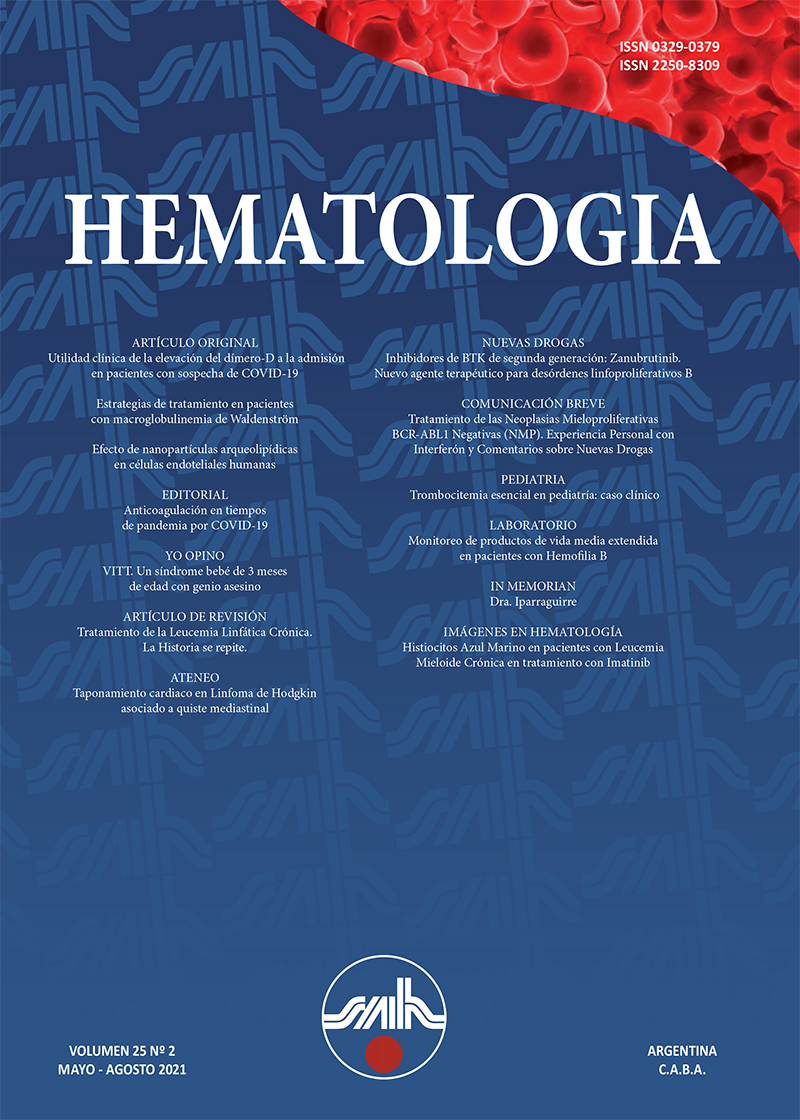
Anemia and fatigue are the most frequent findings at the time of diagnosis. However, most patients remain asymptomatic for long periods, accounting for the chronic and indolent nature of this condition. The objective of this work is to carry out a bibliographic review in order to evaluate which are the treatment strategies and to try to determine the schemes that achieve the best results. In turn, a retrospective observational analysis is carried out on a group of patients with a diagnosis of WM who have undergone treatment, in order to compare the results obtained with the available bibliography.
References
2. Brandefors L, Melin B, Lindh J et al. Prognostic factors and primary treatment for Waldenström macroglobulinemia - a Swedish Lymphoma Registry study. British Journal of Haematology. 2018; 183: 1-14.
3. Treon S, Hunter Z, Aggarwal A et al. Characterization of familial Waldenström’s macroglobulinemia. Annals of Oncology. 2006;17: 488-494.
4. García Sanz R, Jimenez C, Puig N et al. Origin of Waldenstrom's macroglobulinaemia. Best Practice & Research Clinical Haematolog.y 2016; 29: 136-147.
5. Kastritis E, Leblond V, Dismopoulos A et al. Waldenstrom’s macroglobulinaemia: ESMO Clinical Practice Guidelines for diagnosis, treatment and follow up. Annals of Oncology. 2018;29: 1-10.
6. Gertz M. Waldenström macroglobulinemia: 2018 update on diagnosis, risk stratification, and management. American Journal of Hematology. 2018; 94:1-11.
7. Kyle R, Treon S, Alexanian R et al. Prognostic markers and criteria to initiate therapy in Waldenstrom’s macroglobulinemia: consensus panel recommendations from the Second International Workshop on Waldenstrom’s macroglobulinemia. Seminars in Oncology. 2003;3: 116-120.
8. Kyle R, Benson J, Larson D et al. Progression in smoldering Waldenstrom macroglobulinemia: long-term results. Blood. 2012; 119: 4462-4466.
9. Dimopoulos M, Panayiotidis P, Moulopoulos L et al. Waldenström’s Macroglobulinemia: Clinical Features, Complications, and Management. Journal of Clinical Oncology. 2000; 18: 214-214.
10. Dimopoulos M, Tedeschi A, Trotman J et al. Phase 3 Trial of Ibrutinib plus Rituximab in Waldenström’s Macroglobulinemia. The New England Journal of Medicine. 2018;378:2399-2410.
11. G ustine J, Meid K, Dubeau T et al. Serum IgM level as predictor of symptomatic hyperviscosity in patients with Waldenström macroglobulinaemia. British Journal of Haematology. 2017;177: 717-725.
12. Leblond V, Kastritis E, Advani R et al. Treatment recommendations from the Eighth International Work shop on Waldenström’s Macroglobulinemia. Blood. 2016; 128:1321-1328.
13. D ominguez A, Kastritis E, Castillo J. Monoclonal Antibodies for Waldenström Macroglobulinemia. Hematol Oncol Clin N Am. 2018;32: 841-852.
14. K apoor P, Ansell S, Fonseca R et al. Diagnosis and management of Waldenstrom macroglobulinemia: Mayo Stratification of Macroglobulinemia and Risk-Adapted Therapy (mSMART) Guidelines 2016. JAMA Oncology. 2017; 3:1257- 1265.
15. C astillo J, Gustine J, Meid K et al. Response and survival for primary therapy combination regimens and maintenance rituximab in Waldenstrom macroglobulinaemia. British Journal of Haematology. 2018; 181:77-85.
16. K astritis E, Gavriatopoulou M, Kyrtsonis M et al. Dexamethasone, rituximab, and cyclophosphamide as primary treatment of Waldenström macroglobulinemia: final analysis of a phase 2 study. Blood. 2015;126:1392-1394.
17. P aludo J, Abeykoon J, Shreders A et al. Bendamustine and rituximab (BR) versus dexamethasone, rituximab, and cyclophosphamide (DRC) in patients with Waldenström macroglobulinemia. Annals of Hematology. 2018;97: 1417-1425.
18. Rummel M,Niederle N, Maschmeyer G et al. Bendamustine plus rituximab versus CHOP plus rituximab as first-line treatment for patients with indolent and mantle-cell lymphomas: an open-label, multicentre, randomised, phase 3 non-inferiority trial. The Lancet.
2013; 381: 1203-1206.
19. T reon S, Ioakimidis L, Soumerai J et al. Primary Therapy of Waldenström Macroglobulinemia With Bortezomib, Dexamethasone, and Rituximab: WMCTG Clinical Trial 05-180. Journal of Clinical Oncology. 2009;27: 3830-3835.
20. Treon S, Meid K, Gustine J et al. Long Term Follow up of Previously Treated Patients Who Received Ibrutinib for Symptomatic Waldenstrom's Macroglobulinemia: Update of Pivotal Clinical Trial. Blood. 2017;130:2766.
21. Treon S, Gustine J, Meid K et al. Ibrutinib Monotherapy in Symptomatic, Treatment-Naïve Patients With Waldenström Macroglobulinemia. Journal of Clinical Oncology. 2018;36: 2755-2761.
22. Ioakimidis L, Patterson C, Hunter Z et al. Comparative Outcomes Following CP-R, CVP-R, and CHOP-R in Waldenström’s Macroglobulinemia. Clinical Lymphoma and Myeloma. 2009;9: 62-66.
23. L eblond V, Johnson S, Chevret S et al. Results of a randomized trial of chlorambucil versus fludarabine for patients with untreated Waldenström macroglobulinemia, marginal zone lymphoma, or lymphoplasmacytic lymphoma. Journal of Clinical Oncology. 2013;31: 301- 307.
24. Souchet L, Levy V, Ouzegdouh M et al. Efficacy and long-term toxicity of the rituximab + fludarabine + cyclophosphamide combination therapy in Waldenstrom's macroglobulinemia. American Journal of Hematology. 2016;91: 782-786.
All material published in the journal HEMATOLOGÍA (electronic and print version) is transferred to the Argentinean Society of Hematology. In accordance with the copyright Act (Act 11 723), a copyright transfer form will be sent to the authors of approved works, which has to be signed by all the authors before its publication. Authors should keep a copy of the original since the journal is not responsible for damages or losses of the material that was submitted. Authors should send an electronic version to the email: revista@sah.org.ar